Open Licensing: Bento vs. Stir-fry?
Introduction
Examples of academic works that could potentially be created as either remixes (adaptations) or collections include anthologies, readers, encyclopedias, and casebooks. Works like these are often used in large core courses, so they can have a big impact on our students’ access to course materials—and their budgets!
A collection, in particular, could be an excellent place to start if you’re looking to make your first OER contribution. Although less flexible than a remix in terms of how the project can be structured, a collection can bundle together content that is available under a wider variety of licenses.
Collections as a Solution to Licensing Restrictions
In the Open Educational Resources community, we talk about “remixing” as one of the “5 R’s” of OER. And, in an ideal world, we’d have the freedom to remix all our OER content with wild abandon! But what if we want to remix content that uses different, possibly more-restrictive, licenses?
First, not all licenses permit remixing (aka making an “adaptation” or “derivative work”): licenses with the ND clause don’t permit reuse in this way at all.
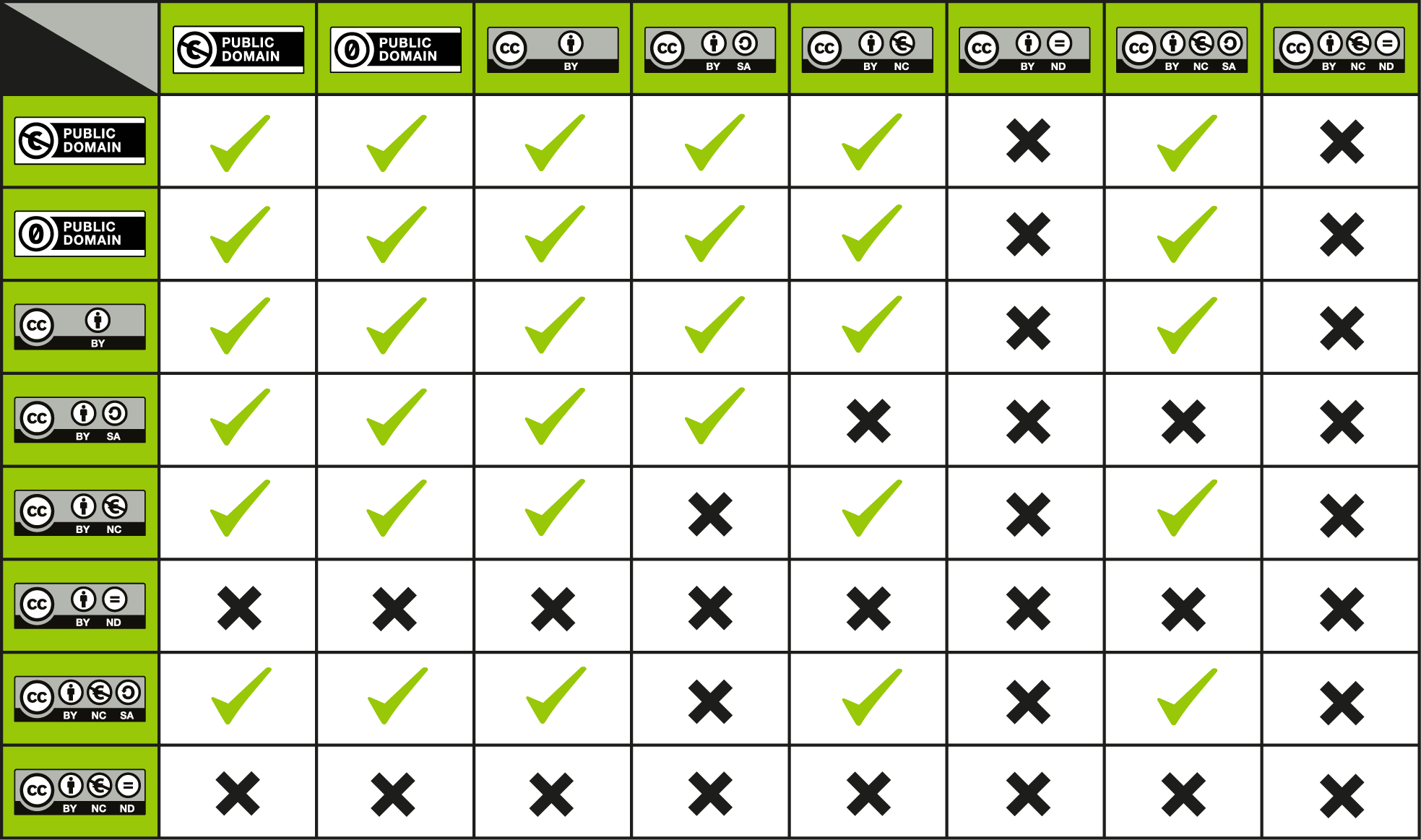
Image: Creative Commons License Compatibility Chart by Creative Commons is licensed under CC BY 4.0
Second, as the Creative Commons FAQ explains, not all licenses can be remixed compatibly. For example, reading across the row for a CC-BY NC work in the accompanying chart, we see that it can be remixed with a CC BY-NC-SA work, but not with a CC BY-ND work.
Thankfully, not every type of reuse of interest to academics constitutes remixing. Rather than blending works together, making changes to the original works in the process, we may want to simply bundle them together for our students. We may choose to collect rather than remix even when restrictive licenses don’t stand in our way if doing so better suits our goals and pedagogical approach.
Stir-fried Remixes vs. Bento Box Collections
Nate Angell has explained the difference between remixes and collections with a wonderful analogy in “Open Licensing Over TV Dinners and Smoothies”, where he likens an adaptation that remixes content into a derivative work to a smoothie. A collection, by contrast, is like a TV dinner—keeping each work in its own compartment.
As much as I love this analogy, I recognize that my students and younger colleagues may never have experienced the joy of eating a Swanson Hungry-Man dinner fresh out of the oven on a TV tray in front of the boob tube. So, I propose a new analogy to take its place: remixes are stir-fry and collections are bento.
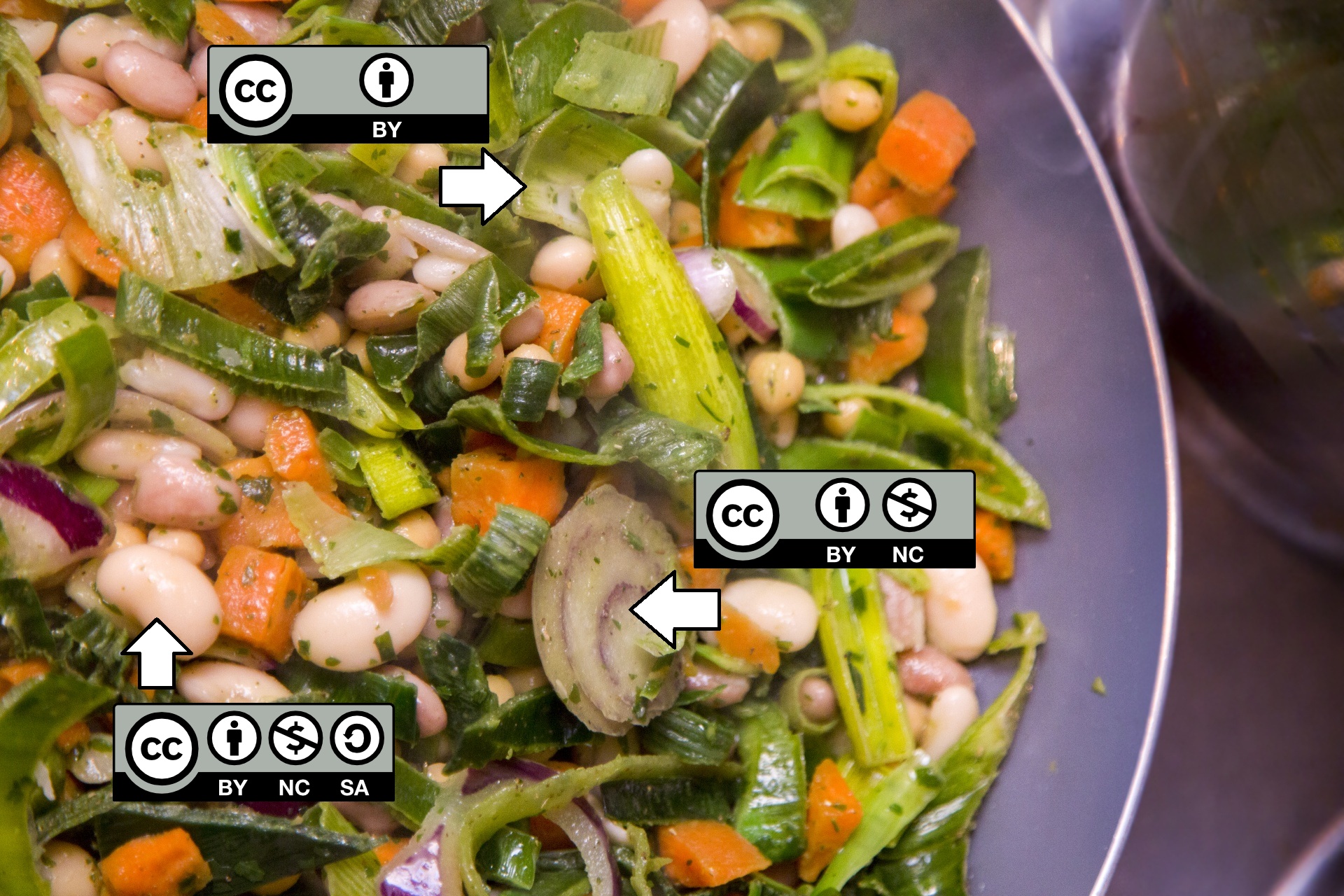
Image: “Stir-fry Remix”, copyright 2026 by Robert Szarka, is licensed under CC BY 4.0 and is a derivative of the CC0 image “Cooked Vegetables in a Pan” by George Hodan and various CC BY Creative Commons license buttons by Creative Commons
In a stir-fry, the ingredients—cabbage, beans, carrots, water chestnuts, etc.—are chopped up, losing their original identities, and commingled to create an entirely new dish. Likewise, a remix of openly-licensed content can adapt and combine multiple works with different licenses to create a new work licensed under a compatible license.
In the accompanying illustration, we see that works licensed under BY, BY NC, and BY NC-SA are mixed together in our stir fry. The resulting work could be licensed under BY NC-SA. However, just as chocolate would probably not work as part of this stir-fry, content licensed under BY SA couldn’t be added to this remix, since licenses with the NC clause aren’t compatible with BY SA. (And, of course, content licensed with an ND clause would be right out.)
With bento, on the other hand, each food remains unchanged in its own compartment, not touching the other food, and compatibility is not an issue. Just as the cold salad in the accompanying illustration avoids getting warmed up and contaminated by the cooked salmon and its sauce, a collection can include content licensed under a wide variety of licenses—in the case of the accompanying illustration, collecting work licensed BY SA, BY NC, BY, and BY ND.
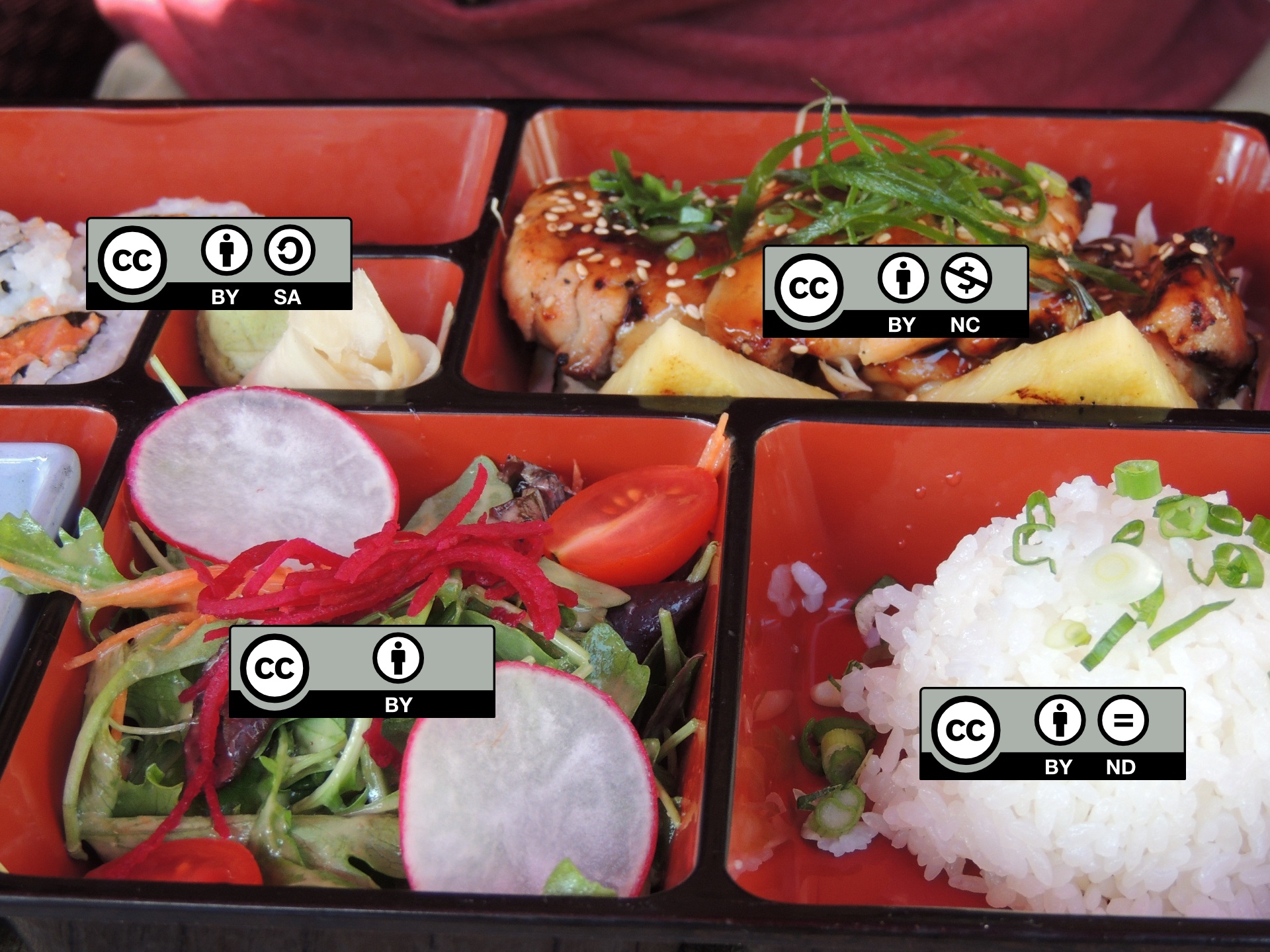
Image: “Bento Collection”, copyright 2026 by Robert Szarka, is licensed under CC BY 4.0 and is a derivative of the CC0 image “Sushi Bento Box” by K Whiteford and various CC BY Creative Commons license buttons by Creative Commons]
An Example Collection: Brit-Lit
Consider Jeremy Larance’s web site Brit-Lit OER. Taking the section devoted to Jane Austen as an example, we find several works already in the public domain and a biographical essay by Emily Bell, licensed CC BY. Each is presented on its own web page, marked with its own license or indication of public domain status. And the overall site includes a notice that, “except where otherwise noted”, the content is licensed under CC BY-NC 4.0.
Because each work is presented separately, it’s clear how any individual work may be reused. And it’s clear how the editor’s work—the contributions of the site as a whole—can be reused. By selecting and arranging Austen’s works, and then selecting accompanying content that adds to a student’s understanding of Austen’s work, Larance and his collaborators have created something that is more than the sum of its parts without compromising the integrity of the parts.
It’s also worth noting that the site is properly classified as a collection, rather than a remix, even though the format of the works may have been changed, e.g., from a print book or plain text file into a web page. The site also allows users to download each work in a variety of other formats. This makes it easy for a potential user of an individual work to obtain the original work to use or adapt on its own under its original license.
See the Creative Commons FAQ for more about choosing a license for the collection as a whole. The key is that, while your choice of license for the collection doesn’t change the licenses of the individual works, your collection still must be used in a way that’s compatible with any works that include the NC clause.
| Original Work | Commercial Collection (BY, BY-SA, BY-ND) | NonCommercial Collection (BY-NC, BY-NC-SA, BY-NC-ND) |
|---|---|---|
| PD | Yes | Yes |
| BY | Yes | Yes |
| BY-NC | No | Yes |
| BY-NC-ND | No | Yes |
| BY-NC-SA | No | Yes |
| BY-ND | Yes | Yes |
| BY-SA | Yes | Yes |
Table: Compatible Collection Licenses (adapted from the Creative Commons FAQ, CC BY 4.0)
Another Example: The Open Anthology of Earlier American Literature
Let’s consider another example: The Open Anthology of Earlier American Literature, edited by Timothy Robbins, adapted from an earlier version edited by Robin DeRosa. Like Brit-Lit, this anthology could be used to replace an expensive commercial textbook for a core literature course. That was one of Robbins’ explicit motivations for creating it.
Also like Brit-Lit, the bulk of this anthology’s content comes from public domain sources. But, for example, the entry for Thomas Jefferson demonstrates that the collection format can also accommodate remixing within one element of the collection: it mixes together an introduction by Samuel Metivier, excerpts from Jefferson’s (presumably, public domain) writings, and annotations by Joshua Tenas into a CC BY licensed adaptation. Likewise, if Tenas wanted to include a CC BY-SA licensed work as another entry in the anthology, he could do so within his CC BY licensed collection without requiring that the entire project be licensed CC BY-SA. (As we saw above, the main source of potential incompatibility for collections is along the commercial/non-commercial dimension.)
I would probably prefer the approach in the Austen-related material from Brit-Lit, because it keeps each work available in a format that can be extracted and easily re-used. But I suspect that the remixing of the Jefferson entry in The Open Anthology better fits Tenas’ pedagogical goals.
Your Turn!
Are you looking to make your first OER contribution? Ask yourself whether there’s a need for a collection of openly-licensed works in your field. But, whichever approach you choose, there’s no better time to start than now!
Thanks to Jonathan Poritz for helpful comments on an earlier draft of this post. Errors remain my own. IANAL. “Park and lock it; not responsible!”